


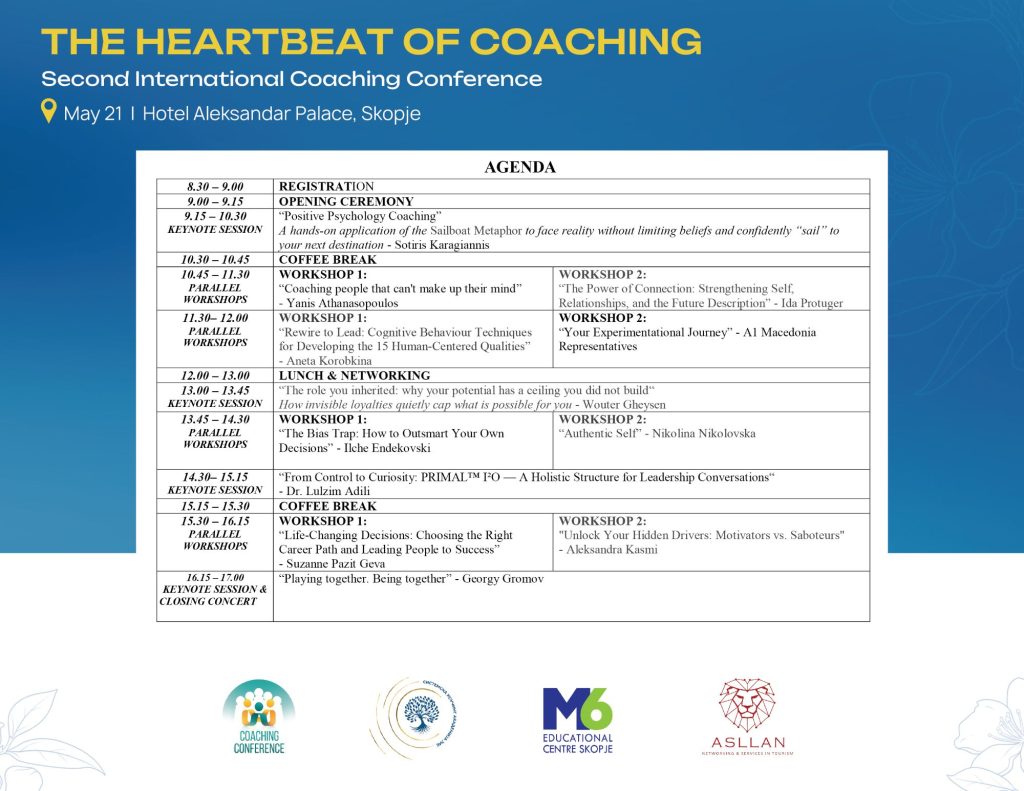
Ahead of the Second International Coaching Conference “THE HEARTBEAT OF COACHING”, taking place on May 21 at Hotel Aleksandar Palace in Skopje, we spoke with Wouter Gheysen — one of the keynote speakers who brings a powerful systemic perspective on leadership, business, potential, and the hidden dynamics that shape human behavior and decision-making.
In this interview, he shares what systemic coaching truly is, how it impacts organizations, and what participants can expect from his keynote session.
Your keynote at ‘’The Heartbeat of Coaching’’ conference focuses on “The role you inherited: why your potential has a ceiling you did not build”. What does it reveal about how people lead, perform, and limit their own potential?
Every leader I have worked with who was genuinely stuck — not superficially stuck, but structurally stuck, in a way where effort and results are persistently out of proportion — was carrying a role they did not choose. A role that was given to them before they had language for it, shaped by their family system, by what the people around them needed, by what was rewarded and what was punished in the world they grew up in.
There’s for example, the Responsible One who cannot stop holding everything, or the Peacekeeper who understands exactly what decision needs to be made to keep the family together. Or the Family Hero who delivers extraordinary results but can’t enjoy them. These are not personality types. They are systemic positions. And the part that most surprises people is this: the constraint is not a wound. It is a loyalty. These leaders are not sabotaging themselves out of fear. They are protecting something or someone in their original family system. And that loyalty runs far below the level where coaching, training, or willpower can reach it.
What the keynote reveals is the mechanism. Once you can see it, you cannot unsee it. And the moment you stop mistaking the role for yourself, something becomes available that was not available before.
Systemic coaching is becoming more present globally, yet still not widely understood. How would you explain systemic coaching in a simple way? And how does it relate to systemic constellations?
The simplest way I know to explain it is this: most coaching focuses on the individual. Systemic coaching focuses on the individual in relation to the systems they belong to — their family, their organisation, and their field of expertise. It works with the reality that we are shaped by the systems we belong to, rather than pretending that reality does not exist.
Think about the iceberg metaphor: you have a visible part above the waterline — the behaviour, the results, the symptoms. Below the water, the invisible part, sit the bigger patterns, habits, beliefs, roles, hidden loyalties and tensions. This invisible layer drives what happens on the surface. Systemic coaching focuses on what is below the waterline, because that is where real and lasting change starts.
Systemic constellations are one of the key tools within systemic coaching. In a systemic constellation, you map a system in a physical or visual way. People or objects represent elements such as team members, roles, goals, and even abstract concepts like “pressure” or “trust.” Once placed, patterns begin to appear. Who is too close, too distant, excluded, or carrying something that is not theirs? Rather than talking about a system, you represent it spatially to make the invisible part of the iceberg visible.
The dynamics that are driving a leader’s behaviour, a team’s dysfunction, or an organisation’s recurring crisis can be mapped, made visible and worked with directly to unlock the true potential.
What first drew you into systemic coaching, and how has your journey evolved over the years?
I discovered systemic coaching by accident when a friend invited me to join a family constellation. As an engineer, I was quite sceptical. However, that session turned my world upside down. I started exploring systemic constellations more and more, attending workshops, which led me to write a master’s thesis in HRM on their use during the recruitment process. My key question was how to select the best candidate for an organisational system and whether the same person is ranked highest during the traditional selection process. The result was surprising and brought a lot of clarity to the recruitment processes of the participating companies, as well as to the hidden patterns in the dynamic between the companies and the candidates. It brought another layer of clarity in the journey to the best hire.
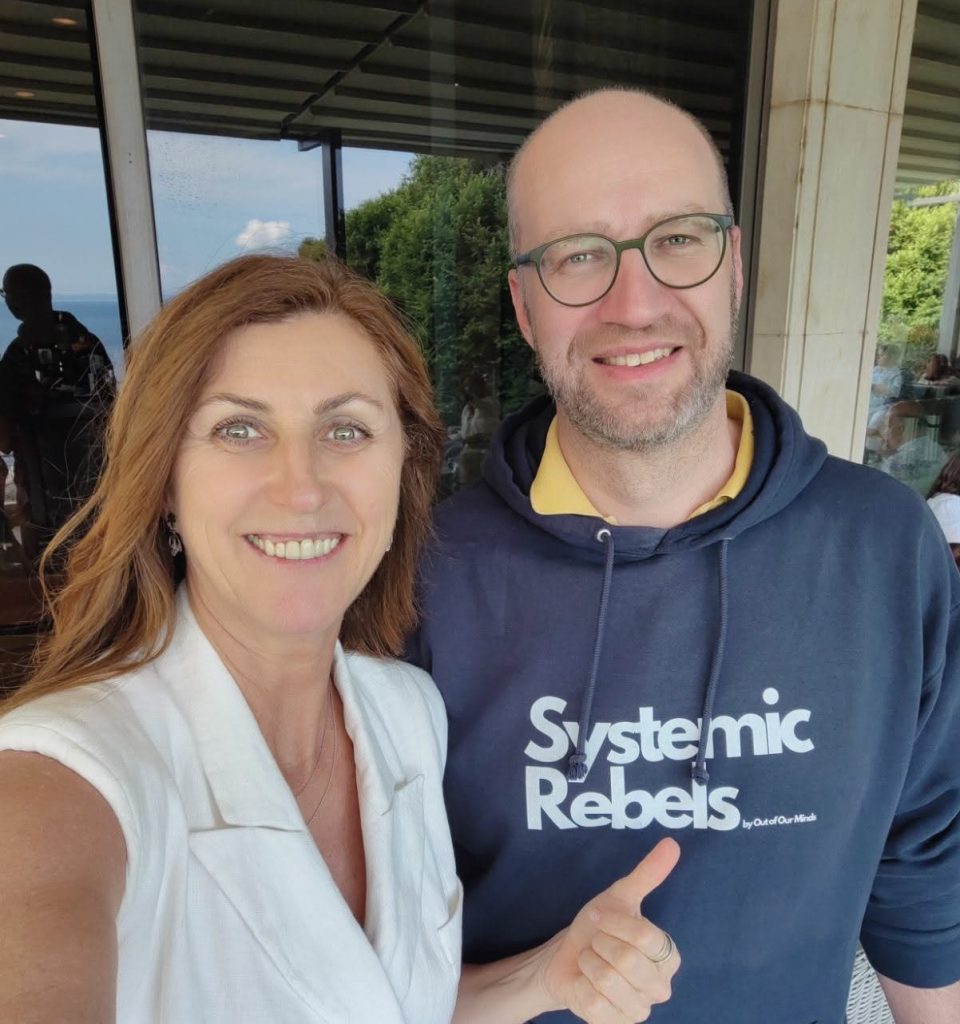
After my master’s thesis was finished, I began training with a broad range of systemic trainers to learn different styles of facilitation, new techniques, and frameworks. Over the years, I have been crystallising my style and niche, combining it with my passion for business and organisational design and for unlocking the potential of people and organisations.
I work now mainly with founders, entrepreneurs and entrepreneurial people who feel they cannot unlock their full potential. They feel they can achieve more but are blocked by inherited patterns or beliefs. Imagine a founder of a start-up which is scaling, looking for funding, but freezes completely when the funding is attributed. Or a start-up founder who is bootstrapping his company not because he wants it that way, but because he is afraid of giving up control or does not want to take big risks — limiting the growth of his start-up in that way. Or the coach who wants to raise the price of his offering but is afraid a doing so.
Many leaders today face complex challenges and often assume the issue lies in skills, confidence, or strategy. How does systemic coaching help uncover hidden dynamics and support better decision-making in organizations? Can you share a real example from your practice where systemic coaching created a significant shift for a leader or a business?
Some time ago, I worked with a CEO and the management team of a food processing company, as there was significant tension and conflict within the team. More specifically, the sales director was always criticising the CEO’s actions and decisions.
In a session with the CEO, we explored this dynamic by mapping the management team’s system with post-its on the table and found that the CEO unconsciously stepped into a child role when he received feedback or was pushed back, while the sales director stepped into a parent role. So the CEO made himself smaller than his role would expect, while the sales director played above his level. Both did it unconsciously, but it had a significant impact on the organisation’s performance. In the mapping, the CEO placed the sales director behind him, which violates the organisation’s hierarchy.
The next day, during a workshop, when I asked the entire management team to find a place in the room to create another mapping of the system, the sales director took a place behind the CEO — confirming the dynamics and the issues with hierarchy in the company. What followed was a set of interventions to restore balance and clarity to the management team. The tension was something everyone could feel, but they did not know there was a violation of order going on — one that was actually rooted in the family systems of both the CEO and the sales director.
What can participants expect during your keynote session at ‘’The Heartbeat of Coaching’’ conference, and how might it challenge the way they see themselves and their role?
They should expect to be in the room differently than they expected. It won’t be a sit-back-and-listen keynote. We’ll work together and make sure they leave the session with more clarity about what’s blocking their true potential, more insights into which role they’ve inherited. Maybe a role, they’ve been living by their whole lives and limiting them.
People know the role they inherited — somewhere, they have always known. But too often the impact of that role has been invisible. They’ve been working harder than almost anyone around them and still hitting a ceiling they cannot explain. They’ve been calling it “personality,” “bad luck,” or “the wrong timing.” This session gives that ceiling a name. And once you can name it, it is no longer invisible. And what is no longer invisible can finally be worked with. So I hope people leave the session feeling lighter. And as it’s the graveyard session, we’ll keep the energy light.
For someone who has never experienced systemic coaching before, what would you say to them? Why is this something worth exploring now, and why is May 21 at “The Heartbeat of Coaching” conference the right place to experience it?
You don’t need to know or understand systemic coaching for it to work. Most people who come to systemic work for the first time arrive skeptical, I did too. Skepticism just means you’re paying attention.
What I would say is this: if there is a pattern in your life or your leadership that you understand but cannot seem to shift, that is the invitation. Not to believe in a method. Just to get curious about what might be running below the surface.
Come to the session. See what you notice. That’s enough.
On May 21, at “The Heartbeat of Coaching” conference in Skopje, this work moves beyond explanation into direct experience.
Invest in your personal and professional development.
Early registration tickets and corporate packages are available.
Full details:https://coachingconference.mk/
